
Niagara Falls: The Facts, Sourced
Height, flow, age, man-made or not: every figure sourced to Niagara Parks or the IJC, and every place the sources disagree flagged instead of smoothed over.
Cite this page
"Niagara Falls Facts & Statistics: Height, Flow, Age, Sourced." Go Tour Niagara, https://gotourniagara.ca/blog/niagara-falls-facts. Last verified September 2026.
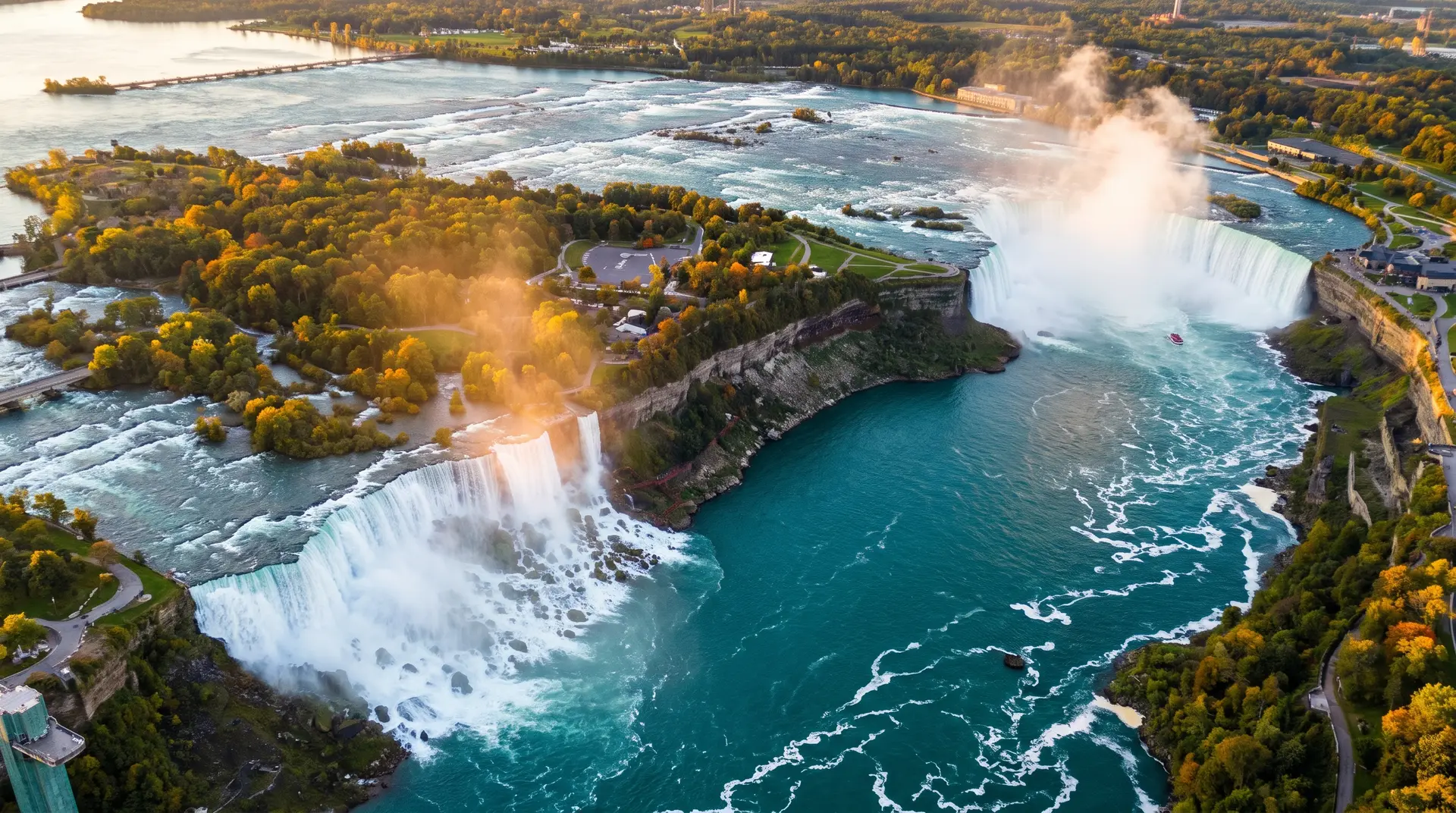
Horseshoe Falls drops 57 metres (188 feet), measured crest to river, according to Niagara Parks Commission, the operator of the Canadian side (checked September 2026).
At its legal treaty floor, Niagara Falls carries at least 1,416 cubic metres of water a second through every night of the year and right through winter (November to March); by day in tourist season that floor doubles to 2,832 m³/s, under the 1950 Niagara River Water Diversion Treaty (checked September 2026).
Niagara Parks’ own geology page dates the region’s ice-free landscape to about 12,500 years ago, but puts the falls’ current configuration at roughly 5,500 years, half the age most listicles quote, because they’re describing two different events.
The falls formed naturally; the flow running over them today is actively managed, with up to half the river’s water diverted to hydroelectric stations outside tourist-viewing hours.
The facts, and how confident anyone should be about each
How tall is Niagara Falls?
Horseshoe Falls is 57 m (188 ft), measured crest to river, per Niagara Parks’ own geology page. American Falls is 21 to 34 m (70 to 110 ft) to the talus rockpile at its base, or 57 m (188 ft) to the river itself, depending on where you measure from.
Several tourism sites give Horseshoe Falls as 51 m (167 ft) instead. That figure does not match Niagara Parks’ own published number for Horseshoe, and looks like a conflation with the American Falls’ talus-adjusted measurement style, or simply an older number copied forward without checking. Niagara Parks’ 188 ft figure is the one to use.
Bridal Veil Falls, the small third cascade between the other two, is not broken out separately on Niagara Parks’ own facts page. Third-party guides give it as roughly 78 ft drop and 56 ft wide. Treat that as approximate: it is not Niagara Parks data.
How much water goes over Niagara Falls?
This is the one figure almost nobody quotes with the context it needs. Niagara Parks says more than 168,000 cubic metres go over the crestline every minute at peak daytime tourist hours. But the number that actually goes over the falls at any given moment depends on the 1950 Niagara River Water Diversion Treaty’s legal minimums, which change by time of day and season:
| Regime | When | Legal minimum |
|---|---|---|
| Daytime, tourist season | Apr 1 to Sep 15, 8am to 10pm; Sep 16 to Oct 31, 8am to 8pm | 2,832 m³/s (100,000 cfs) |
| Every other hour, including all of Nov to Mar | Nights year-round, and every hour of winter | 1,416 m³/s (50,000 cfs) |
Horseshoe Falls carries about 93% of that total, American Falls the remaining 7%, per Niagara Parks’ own “Frozen Falls” page. That page also states the same figures in litres per minute (85 million winter, 170 million summer daytime), which is where a lot of the “40 million gallons a minute” and similar unit-conversion claims circulating online actually trace back to, once you convert.
Niagara Parks’ own marketing claim of “more than 168,000 cubic metres a minute” at peak is a per-minute figure. Divide by 60 and it lands almost exactly on the daytime tourist-season minimum above, which is where the “roughly 2,800 cubic metres a second” figure you see everywhere comes from. It is correct for daytime, summer-tourist-season hours. It is not a year-round constant, and it is exactly double the winter figure. Full breakdown, with the freeze history that makes this matter, in does Niagara Falls freeze?.
How old is Niagara Falls?
Niagara Parks’ own geology page carries two different numbers, and the difference matters. The Niagara Peninsula became ice-free roughly 12,500 years ago, at the end of the last glaciation. But the falls’ current configuration, in their present form and location, is put at roughly 5,500 years old: the meltwater took thousands of years to carve its way to where the falls sit today.
The “12,000 years old” figure repeated almost everywhere describes the first event, not the second. It is not wrong exactly, it is answering a different question than the one being asked. This is a real disagreement inside Niagara Parks’ own single most authoritative source, not noise from a secondary site.
We stop at the falls, not just drive past them
Private SUV from Toronto, licensed guide, a full day at the falls plus Niagara-on-the-Lake, the Whirlpool and the Floral Clock. $585 flat for up to 5 (about $117 each).
Prefer the details first? See the full private Niagara Falls tour from Toronto.
Is Niagara Falls man-made?
No, and also not a flat yes. The falls are natural in origin, carved by glacial meltwater over thousands of years. But the flow you see today is actively regulated: the 1950 Treaty minimums above are the legal floor, and up to about half the river’s water is diverted to hydroelectric stations, Sir Adam Beck on the Canadian side and Robert Moses on the US side, outside the hours tourists are looking.
“Natural falls, managed flow” is the honest answer. Many pages collapse it into a flat yes or no, which misses the actual mechanism: what you are standing in front of is a real waterfall running on a deliberately reduced supply.
One overstated claim worth avoiding: several tourism-blog sources say the Lake Erie ice boom means the falls will “never freeze over again.” The ice boom’s own operators describe its purpose as reducing the frequency and severity of ice jams, not guaranteeing it can never repeat. More on that in does Niagara Falls freeze?.
The two numbers we won’t publish
Annual visitors. You will see 12 to 14 million a year quoted constantly. Those figures come from tourism-marketing and economic-development bodies, not a government turnstile count, and there is no border-crossing counter that isolates “visited the falls specifically” from broader regional travel. We would rather say plainly that no authoritative count exists than repeat a number nobody actually counted.
Total deaths and suicides. A number of specific daredevil deaths are well documented by name and date: Charles Stephens (1920), George Stathakis (1930), William “Red” Hill Jr. (1951), Jesse Sharp (1990), Robert Overacker (1995), Kirk Jones (2017). Those are safe to cite individually. Aggregate “total deaths since 1850” and suicide-count figures circulating online all trace back to content-aggregator sites, not a coroner’s office or public-health authority. We are not publishing a total.
Methodology & sources
Every confirmed figure on this page traces to Niagara Parks Commission’s own geology and “Frozen Falls” pages (niagaraparks.com), the operator of the Canadian side, or to the International Joint Commission (ijc.org) and the text of the 1950 Niagara River Water Diversion Treaty. Where a figure is only available from a third-party guide, it is marked unverified and shown with that hedge intact rather than presented as if it came from the primary source. Where Niagara Parks’ own site states two different numbers, as with the falls’ age, both are shown and attributed rather than one being quietly picked.
Checked 25 September 2026. If you have a primary source that updates or reconciles anything here, we would like to see it: info@gotourniagara.ca.
Frequently asked questions
How tall is Niagara Falls?
Horseshoe Falls is 57 m (188 ft), American Falls is 21 to 34 m (70 to 110 ft) to the talus or 57 m to the river depending on measurement point, both per Niagara Parks. A commonly repeated 167 ft figure for Horseshoe does not match Niagara Parks’ own published number and looks like an older or conflated figure circulating on secondary sites.
How much water goes over Niagara Falls per second?
It depends which regime you mean: at least 1,416 m³/s at night and all winter (the treaty floor), at least 2,832 m³/s by day in tourist season. Niagara Parks’ own "168,000 m³ per minute" peak claim is a per-minute figure that gets misquoted as per-second. Divided by 60 it lands almost exactly on the daytime tourist-season minimum, which is where the "2,800 cubic metres a second" figure seen all over the web actually comes from.
How old is Niagara Falls?
Roughly 5,500 years in its current form and location, per Niagara Parks’ own detailed geology page, not the "12,000 years" figure repeated almost everywhere, which describes when the last ice sheet retreated from the region, a different and older event.
Is Niagara Falls man-made?
No, it’s a natural waterfall carved by glacial meltwater. But the flow you see is actively regulated: up to about half the river is diverted to Sir Adam Beck (Canadian side) and Robert Moses (US side) hydroelectric stations outside the hours tourists are looking. "Natural falls, managed flow" is the honest answer; most pages collapse this to a flat yes/no.
How many people visit Niagara Falls each year?
No government agency publishes a turnstile count. The 12 to 14 million/year figures you’ll see are tourism-marketing and economic-development estimates, not an audited number. We’d rather say that plainly than repeat a number nobody actually counted.
How many people have died going over Niagara Falls?
A number of specific daredevil deaths are well documented by name and date (Charles Stephens 1920, George Stathakis 1930, William "Red" Hill Jr. 1951, Jesse Sharp 1990, Robert Overacker 1995, Kirk Jones 2017). Aggregate totals and suicide-count claims circulating online trace back to content-aggregator sites, not a coroner’s office or public-health authority, so we’re not publishing a total.
More on the falls in winter: does Niagara Falls freeze? and is it worth visiting in winter?. Nearby, sourced the same way: the Niagara Whirlpool, the Floral Clock, and Canadian side vs American side. Planning a trip: the best time to visit.